Why High Turnover Is a Design Problem, Not a Hiring Problem
Most organizations are trying to solve a retention crisis with a recruitment strategy. Here's why that never works.
ORGANIZATIONAL DESIGN
There is a question I hear from founders and managers with remarkable consistency: "How do we find better people?"
It's the wrong question.
Not because talent acquisition doesn't matter; it does. But when turnover is high and the cycle keeps repeating, the issue is rarely who you're hiring. It's what you're hiring them into.
The Expensive Cycle Nobody Talks About
Replacing a mid-level employee costs somewhere between six and nine months of their salary when you factor in recruitment, onboarding, lost productivity, and the institutional knowledge that walks out with them. For senior roles, that number climbs higher.
Most organizations absorb this cost silently; budgeting for it the way you'd budget for a utility bill. Expected. Recurring. Unpleasant but unavoidable.
It is not unavoidable. It is a signal.
High turnover is one of the most expensive ways an organization communicates that something in its design is not working. The people leaving are not the message. Their departure is the receipt.
(If you haven't read The Quiet Resignation yet, that's a good place to start.)
What Hiring Better People Actually Solves
Here is what a stronger hire gets you: a more talented person experiencing the same broken system.
If roles are unclear, a brilliant new hire will be confused by them. If feedback loops don't function, an emotionally intelligent new team member will eventually stop offering feedback. If the culture quietly penalizes speaking up, the most confident candidate you interviewed will learn; within months; to stay quiet.
Talent does not override environment. Environment shapes behavior. This is not a controversial claim in organizational psychology; it is foundational to it. And yet the instinct to solve structural problems by upgrading the humans inside them is almost universal.
It's understandable. Hiring feels like action. Redesigning a system feels abstract, slow, and harder to explain to a board.
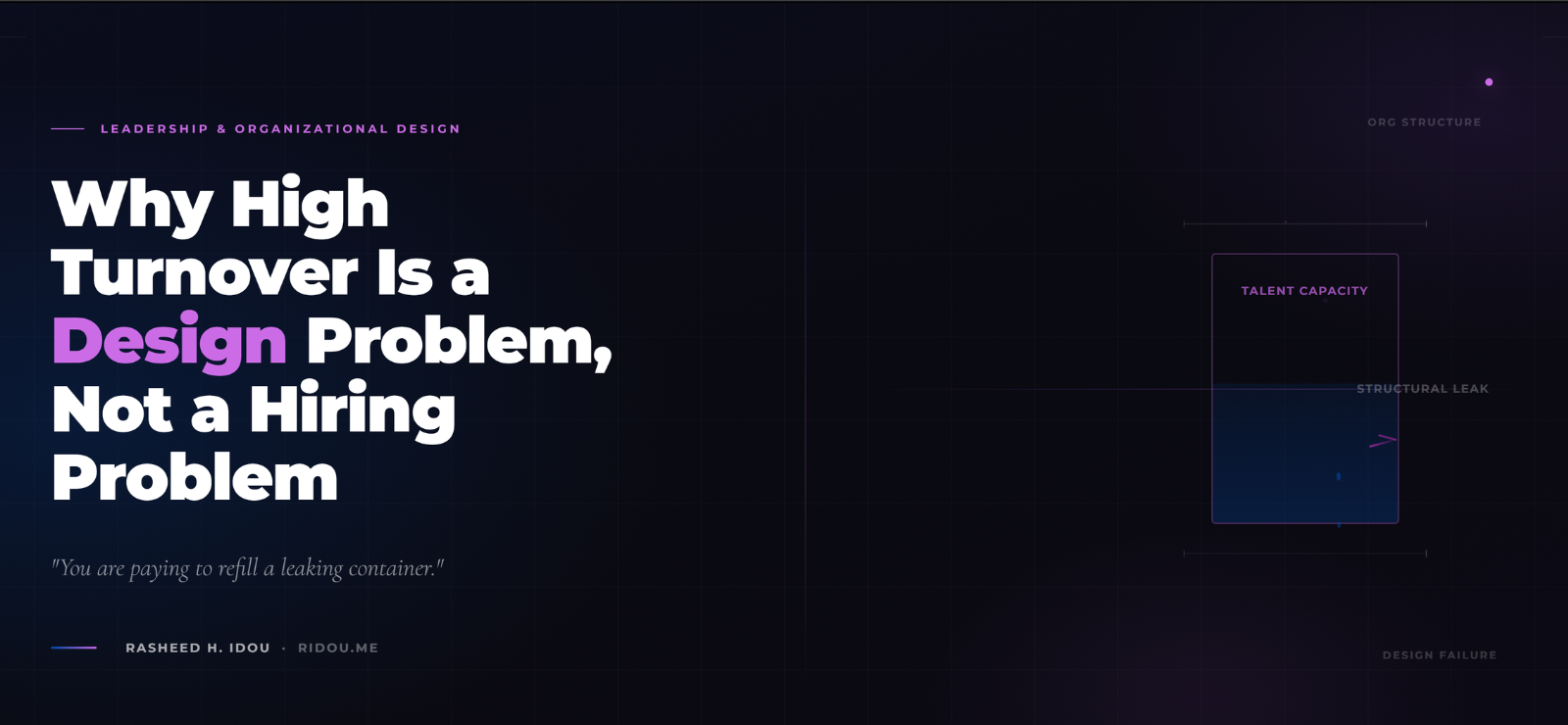
But the math is unforgiving. If your retention problem is structural and you're solving it with recruitment, you are paying to refill a leaking container.
What a Design Problem Actually Looks Like
Structural retention problems tend to share a recognizable shape. The specifics vary; the patterns don't.
Unclear ownership. People don't know where their role ends and someone else's begins. This produces either conflict or paralysis; sometimes both. Talented people find this intolerable quickly.
Broken feedback loops. Information travels downward efficiently but struggles to move upward. People learn that raising concerns produces no visible outcome; so they stop raising them. The organization loses its early warning system without noticing.
Misaligned recognition. The behaviors that get rewarded are not the behaviors the organization says it values. People are perceptive. They adjust to what is actually incentivized; not what is written in the values document.
Growth ambiguity. High performers need to see a plausible path forward. When that path is unclear or appears to depend more on politics than performance, the people with the most options leave first. They always do.
None of these are personality issues. None of them get fixed by finding someone more resilient, more adaptable, or more patient. They get fixed by redesigning the conditions that produce them.
The Question Worth Asking Instead
When turnover is high, the most useful diagnostic question is not "what's wrong with the people we're hiring?"
It's "what does our organization reliably produce in the people who join it?"
That reframe is uncomfortable. It locates the problem closer to home. But it is also the only reframe that leads to a solution that actually holds; because it focuses attention on the one thing you can directly control: how you build.
Recruitment is a response to turnover. Organizational design is a response to its cause.
The organizations that retain the people worth retaining are not necessarily the ones with the best hiring processes. They are the ones that built something worth staying for.
If you'd like to explore what that looks like in practice, here's how I work with organizations.
If your organization is caught in a turnover cycle and the usual fixes aren't holding, that's usually a signal worth paying attention to. Exploratory conversations are free; you can request a consultation directly through the button below.